
How To Use High Speed Sync Underwater
Check out our video where we not only explain what HSS is, but we also display some of the biggest myths surrounding it. Click here to watch on YouTube.WHAT IS HIGH SPEED SYNC? Shooting macro in bright, shallow water can create a frustrating problem. At a wide-open aperture, your camera's maximum flash sync speed may not be fast enough to reduce ambient light. Instead of a rich black background, you end up with a bright, washed-out blue or cyan backdrop. High Speed Sync (HSS), also known as Focal Plane Sync (FP) on some camera systems, solves this problem by allowing you to shoot with a flash at shutter speeds far beyond the camera’s normal flash sync speed. But HSS isn’t simply a “better” way to shoot with a flash. It comes with significant trade-offs, including reduced effective strobe power and slower recycle times. Used in the right situation, however, HSS is a valuable tool for shooting macro in bright ambient light or for creative shallow depth of field images.Without HSSOlympus E-M10 IV | Olympus 60mm Lens | 1/125 | ISO 200 | ƒ5.6With HSSOlympus E-M10 IV | Olympus 60mm Lens | 1/1,125 | ISO 200 | ƒ5.6High Speed Sync (HSS) lets you shoot beyond your camera’s normal flash sync speed, making it possible to use wide apertures while keeping bright, shallow-water backgrounds dark. A black background helps the subject stand out, especially when it’s camouflaged or surrounded by distracting scenery.BREAK THE FLASH SYNC SPEED LIMIT Most cameras with traditional rolling shutters have a maximum flash sync speed of around 1/200 or 1/250 second. At or below that speed, the entire sensor can be exposed at once, allowing a normal flash to illuminate the frame. Go beyond the camera's sync speed, however, and the shutter curtains move across the sensor as a narrow slit. Fire a normal flash during that exposure, and part of the frame can be blocked by the shutter curtain, creating a dark band across the image. When a normal flash fires beyond the camera’s flash sync speed, a dark bar can appear in the frame because the shutter curtains are only exposing part of the sensor when the flash fires. HSS gets around this limitation by changing how the strobe fires. Instead of producing one powerful flash burst, an HSS-compatible strobe rapidly pulses light throughout the exposure. This keeps the sensor illuminated as the narrow slit between the shutter curtains moves across it, avoiding the dark band. Watch this short animation to see how HSS interacts with your camera’s shutter. Instead of firing a single burst, HSS rapidly pulses throughout the exposure, lighting the entire image without creating a dark band. This allows an image to be exposed with shutter speeds far beyond the normal sync limit, up to 1/8,000 second on some cameras. Underwater, that extra shutter speed can make a dramatic difference. With normal sync, bright shallow water may force you to stop down the aperture or accept a bright blue background, while HSS lets you increase the shutter speed enough to cut the ambient light and keep the aperture wide open. The result is a dark or even black background while maintaining the shallow depth of field that makes macro images stand out. Without HSSOlympus E-M10 IV | Olympus 60mm Lens | 1/250 | ISO 200 | ƒ4With HSSOlympus E-M10 IV | Olympus 60mm Lens | 1/2,500 | ISO 200 | ƒ2.8While many cameras are limited to flash sync speeds around 1/200 or 1/250 second, HSS can extend that range to as fast as 1/8,000 second, depending on the camera. This gives photographers far more flexibility when controlling ambient light.DEMYSTIFYING HSS Over the years, we’ve heard plenty of misconceptions about HSS at Backscatter. Understanding its limitations is just as important as knowing what it can do. Let’s bust some common HSS myths so you can make the most of this unique flash mode. FAST SHUTTER, NOT FAST SHOOTING One of the most common misconceptions about HSS is that it's designed for rapid-fire shooting. The “High Speed” in HSS refers to shutter speed, not shooting speed. HSS doesn't make your camera or strobe better suited to capturing a high number of frames per second, it's actually the opposite. Because the strobe rapidly pulses throughout each exposure, HSS uses more of the strobe's available energy than a normal single flash burst. This increases recycle times and makes it harder to maintain a high frame rate, particularly when shooting continuously. For fast-moving subjects where rapid-fire shooting is important, standard flash sync is the better choice. HSS is about giving you a faster shutter speed, not helping you take more pictures per second. HSS uses more strobe power than normal flash modes, meaning it has a slower recycle time. This makes it best for shooting slow-moving or stationary subjects rather than capturing fast action.Sony a1 | Sony 90mm Lens | 1/1,000 | ISO 50 | ƒ2.8FASTER ISN'T ALWAYS BETTER Having access to an extremely fast shutter speed doesn't mean you should always use it. Since HSS causes the flash to act more like a continuous light source, your shutter speed influences how bright it appears in the image. This means the fastest shutter speed will result in a darker exposure. You can actually use this to your advantage, as shutter speed becomes another way of controlling the amount of strobe light reaching the sensor. Think of it almost like a dimmer switch. Need more light from the strobe? Slow the shutter speed down. Need less light? Speed it up. The goal isn't to use the fastest shutter speed your camera offers. The goal is to use the shutter speed that still gives you enough strobe exposure on your subject. With HSS, shutter speed acts like a dimmer switch for your strobe. Rather than simply cranking the shutter speed to the maximum, choose a speed that gives your subject the right amount of light. If the subject is too dark, slow the shutter speed; if it’s too bright, speed it up. HSS FALLS SHORT FOR BIG SCENES The biggest practical downside to HSS is power. With normal flash operation, the strobe dumps a large amount of energy into a single, short burst. HSS, on the other hand, spreads that energy across a rapid series of pulses during the exposure. That makes the light behave more like a video light than a strobe, at the expense of flash output. For wide-angle photography, the reduced power of HSS is a serious limitation. Wide angle imaging often requires more power from a strobe to light bigger scenes and overcome ambient light. Although the faster shutter speeds allowed by HSS would be useful for high-ambient-light wide-angle scenes like sunballs, the reduced strobe power and slower recycle times make it impractical for most wide-angle applications. This image was captured with normal strobe power, not HSS. A big scene with a sunball requires substantial strobe power to light the foreground. Because HSS reduces effective flash output, lighting large scenes becomes much more difficult.Canon EOS R1 | Canon 8-15mm Lens | 1/200 | ISO 320 | ƒ13THE SWEET SPOT: MACRO HSS is a fantastic lighting option for specific macro shots. With macro, your subject may be only a few inches from the front of the lens. You don't need your strobe to throw light across a huge reef or illuminate a distant subject. That close working distance makes HSS's reduction in effective power much less important. At the same time, shallow-water macro creates exactly the exposure conditions where HSS is most useful: lots of ambient light, a desire for a wide aperture, and a need for a fast shutter speed to create a darker background. Without HSSOlympus E-M10 IV | OM System 90mm Lens | 1/160 | ISO 200 | ƒ5With HSSOlympus E-M10 IV | OM System 90mm Lens | 1/4,000 | ISO 200 | ƒ5HSS is best suited to macro photography, where the close working distance makes its reduced strobe power less of a limitation, while fast shutter speeds help reduce ambient light for dramatic black backgrounds.BEWARE OF HSS BANDING There's one more HSS problem to watch for: banding. If you start seeing dark stripes or bands across your images, your strobe isn’t the problem. Banding is usually an interaction between the camera's shutter settings and the rapid pulses produced by the strobe. Banding is a common phenomenon when using HSS, and is an interaction between the camera’s shutter and rapid pulses of the strobe. To remedy banding, you may need to make some adjustments in your camera’s menu.Sony a7R V | Sony 90mm Lens | 1/8,000 | ISO 125 | ƒ3.5 On Sony cameras, for example, HSS operation requires the camera's shutter type to be set to Mechanical, with Electronic Front Curtain Shutter turned off. The exact settings will vary by camera, so it's important to check the requirements for your particular camera and trigger combination. To prevent banding with Sony cameras, make sure the shutter is set to mechanical and e-front curtain is set to off.WHAT ABOUT GLOBAL SHUTTER? Cameras with a global shutter, such as the Sony a9 III, completely bypass traditional flash sync limits and the use of HSS. Global shutters expose the entire sensor simultaneously without a mechanical shutter, allowing you to sync a standard flash at any shutter speed. This gives you the main benefit of HSS, letting you use fast shutter speeds to darken bright ambient light without the usual HSS power drain. This means you can use your strobes at maximum output to light your subjects, and your recycle times stay fast. Ultimately, this makes it much easier to properly expose wide-angle scenes compared to using HSS. Global shutter isn’t without limitations. At extremely fast shutter speeds, flash duration can affect exposure, so performance may vary depending on the camera, strobe, and settings. Even so, global shutter offers significant advantages over HSS. Global shutter cameras can sync with a normal flash burst at high shutter speeds, allowing you to reduce ambient light in large scenes while retaining the strobe power that HSS lacks.Sony a9 III | Canon 8-15mm Lens | 1/2,000 | ISO 200 | ƒ10REQUIRED EQUIPMENT FOR HSS HSS isn't something you can simply turn on in the camera and expect every flash trigger and underwater strobe to support. Your trigger and strobe both need to be compatible with HSS operation. Compatible trigger options include the Backscatter Smart Control TTL Triggers, Turtle Triggers, and UW Technics Triggers. On the strobe side, HSS is supported by several models, including the AOI Q1i, AOI Q1 RC, AOI UIS-P1, Backscatter Mini Flash 3, Backscatter Atom Flash, and Backscatter Hybrid Flash, Isotta Red64, Retra Flash Pro Max II, Retra Flash Maxi, Seacam 160D, and Sea&Sea YS-D130R strobes. Because compatibility can depend on the specific camera, trigger, and strobe, it's worth confirming your complete setup before investing in an HSS system. If you have any questions about HSS compatibility with your system, contact us, and we’ll make sure you have the right parts. In order to activate HSS, you’ll need an HSS Flash Trigger such as a Turtle TTL trigger, a Backscatter Smart Control TTL Flash Trigger, or a UW Technics TTL Trigger.In addition to a compatible flash trigger, you will also need a strobe capable of firing in a HSS mode.CONCLUSION High Speed Sync isn't a replacement for normal flash synchronization. It's a specialized tool for situations where your camera's normal sync speed can't give you the exposure you want. HSS is particularly valuable for open-aperture macro in bright, shallow water, where its advantages are maximized and disadvantages are minimized. For most other situations, especially wide angle or fast action, using normal flash modes are usually the better choice. If you're not sure whether your current camera, trigger, and strobe combination supports HSS, or you're building a new macro setup, contact Backscatter or one of our authorized dealers. We can help you determine what's compatible and how to configure it. WHY BUY FROM BACKSCATTER?Free lifetime tech support with every purchase. We will beat any advertised price. 20+ years of in-house warranty service and repair. Free shipping to the USA and Canada, and low-cost international shipping.Learn more!HSS STROBESAOIAOI UIS-P1 StrobeORDER NOWAOI Q1i StrobeORDER NOWAOI Q1 RC StrobeORDER NOWBackscatterHybrid Flash Strobe & Video LightORDER NOWAtom Flash StrobeORDER NOWMini Flash 3 StrobeORDER NOWIsottaIsotta Red64 StrobeORDER NOWRetraRetra Flash Maxi StrobeORDER NOWRetra Flash Pro Max II Strobe and Booster PackageORDER NOWRetra Flash Pro Max II StrobeORDER NOWSea & Sea Sea & SeaYS-D130R Pro Strobe PackageORDER NOW Sea & SeaYS-D130R StrobeORDER NOWSeacamSeacam 160D StrobeORDER NOWHSS FLASH TRIGGERSBackscatterBackscatter Nauticam Flash Trigger for SonyORDER NOWBackscatter Universal Flash Trigger for SonyORDER NOWBackscatter Universal Flash Trigger for Olympus and OM SystemORDER NOWTRT TTLTRT TTL s-TURTLE 3 SMART Sony Flash TriggerORDER NOWTRT TTL i-TURTLE 3 SMART Nikon Flash TriggerORDER NOWTRT TTL e-TURTLE 3 SMART Canon Flash TriggerORDER NOWTRT TTL O-Turtle 2 SMART+ OM & Olympus Flash TriggerORDER NOWUW TECHNICS UW Technics Internal TTL ConverterORDER NOW UW Technics External TTL ConverterORDER NOW
Related Posts

Backscatter Hybrid Flash Underwater Strobe & Video Light Review
With the introduction of the Backscatter Hybrid Flash HF-1, underwater photographers can now capture stunning stills and video with a single versatile tool. The Hybrid is the most powerful strobe and ...
Read More 
Sony 8-14mm Fisheye Lens — First Look Underwater
For years, Sony full-frame underwater shooters have had a glaring hole in their gear bags: the lack of a native fisheye lens. To get that classic ultra-wide perspective, our only real option was to sh...
Read More 
How To Use High Speed Sync Underwater
Shooting macro in bright, shallow water can create a frustrating problem. At a wide-open aperture, your camera's maximum flash sync speed may not be fast enough to reduce ambient light. Instead o...
Read More 
Nauticam MFO-1, MFO-3, & SMC-3 Underwater Macro Lens Review
What if you could transform your camera’s macro lens into three radically different tools? That’s exactly what Nauticam’s MFO-1, Nauticam SMC-3, and Nauticam MFO-3II make possible. While they may look...
Read More 
Sony a7R VI Underwater Camera Review
The Sony a7R VI is the latest generation of Sony's high-resolution full-frame mirrorless camera, and on paper, it looks like a relatively modest update to the already excellent Sony a7R V. The re...
Read More 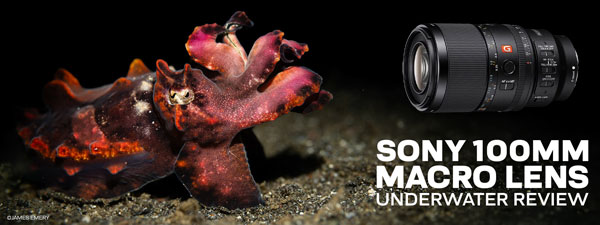
Sony 100mm Macro Lens Underwater Review
The Sony 100mm is the most exciting new macro lens for underwater imaging we have seen in years. Featuring high-quality, razor-sharp G Master series glass, enhanced autofocus performance, a native 1.4...
Read More