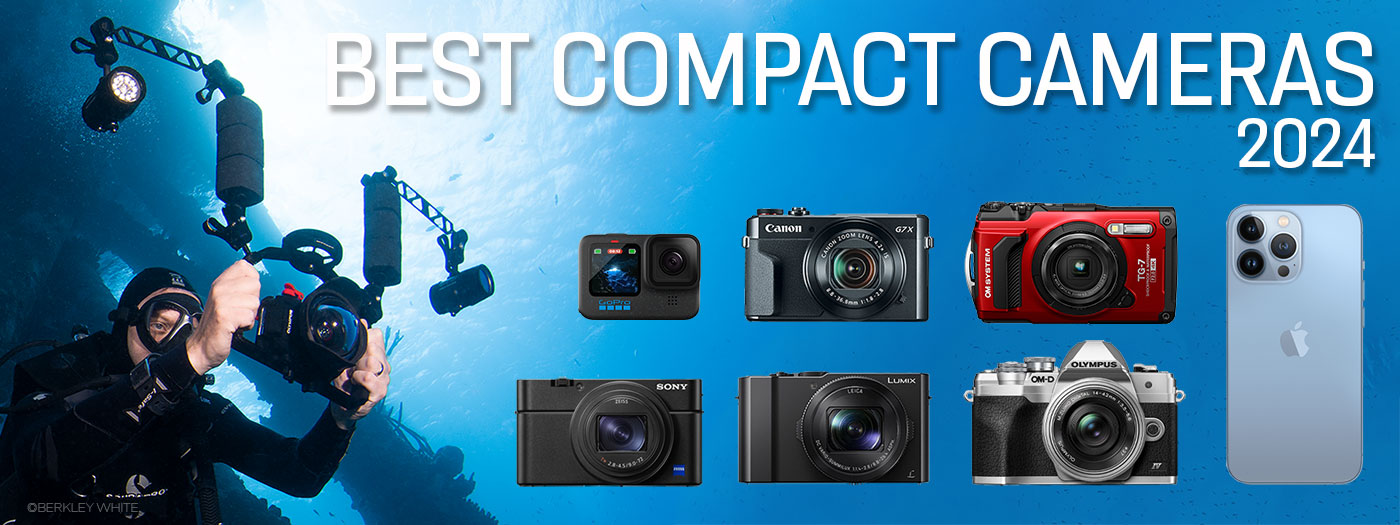
Best Underwater Cameras of 2024: Compact Cameras
Not an Open Box Review - This is Rigorous Underwater Testing The Backscatter team spent hundreds of hours testing the best underwater cameras to find the best and not-so-good cameras for underwater photography. We publish this article annually from the results of our tests. This article is updated as new cameras are released and tested. [ latest update January 2024 ] Why use a compact camera? Compact cameras are some of the best cameras for shooting underwater, as they are often easy to learn, easy to dive and travel with, and less expensive than their SLR counterparts, while still yielding outstanding image results and fast shooting speeds. Backscatter compiles this guide every year to eliminate the hassle and headache of trying to pick the best compact camera and underwater housing for your photo and video needs. Whether you are just getting started with underwater photography or are already an experienced image maker looking for the latest compact rig, this roundup of the best current compact cameras for underwater photography is the best resource online to find the perfect underwater camera. Summary of the Best Underwater Compact Cameras for 2024Best Compact Video Camera GoPro HERO12 with FLIP12 FiltersGO TO HERO12Best All Around Compact Camera OM System TG-7GO TO TG-6Best Advanced Compact Camera Olympus E-M10 IVGO TO E-M10 IVAdvanced Runner-up #1 Sony RX100 VIIGO TO RX100 VIIAdvanced Runner-up #2 Canon G7 X IIIGO TO G7X IIIAdvanced Runner-up #3 iPhone 14GO TO iPhoneKeep reading for more information about each camera and our testing criteriaOur Breakdown of CategoriesWe divided our top picks into three categories:Best Compact Video CameraBest All Around Compact CameraBest Advanced Compact Camera There is no one camera that is the best at everything. One may be the best for image quality, but cannot execute a custom white balance underwater for video. Another may be the fastest shooting camera that we’ve ever seen, but cannot focus close for macro. Because of this we also included runners up in this review in addition to our top pick. Our top picks are our best all-around choices taking into consideration serving the needs of the broadest segment of users for both photo and video. Depending on an individual’s shooting style, subject interest, and shooting goals, a runner up may be a better option than one of our top picks for that particular individual. The staff at Backscatter have extensive experience with every camera in this article and can help guide your decision about which camera for underwater photography is best for your individual needs. How We Selected: Our 2024 Test CriteriaTarget UsersNew underwater photographer wanting an easy point-and-shoot camera with growth potential.Advanced underwater photographer wanting a compact camera solution.Camera Feature RequirementsGreat to excellent image quality.A camera must be compact and lightweight when used topside.A camera must be point-and-shoot easy, but offer intermediate to advanced controls.Underwater housing must offer wide-angle potential.Wide Angle Lenses Many compact cameras are incompatible with underwater wide-angle lenses. Most of these cameras feature a 5X or greater zoom lens. While this might be attractive for topside photography, long zoom lenses require underwater housings designs with long lens ports. Accessory wide-angle lenses must mount to the end of these ports and suffer from severe vignetting (dark corners) when the camera is zoomed out. You can zoom in the camera lens to clip out the dark corners, but an extreme zoom will negate any benefit of using a wide angle lens. Our compact camera finalists in this review offer great wide-angle lens solutions by the original manufacturer or a high-quality third-party solution. Slave TTL Strobes In recent years strobe manufacturers have developed an automatic exposure system called slave TTL. When set to slave TTL mode, the underwater strobe simply mimics the camera's built-in flash to produce an automatic strobe exposure. While no automatic system will yield perfect results 100% of the time, this system works reasonably well and can help someone who is just starting out to get some good shots on their first few times using a camera underwater. Understanding how TTL systems work, how to judge exposures, and working within a camera system's limitations will be a photographer's best tools for creating the perfect photograph. Video The video capabilities of compact cameras have evolved from a novelty to the level of those that can rival a primary video cameras. Many of the cameras in our lineup produce video that is surprisingly good for the cost of the camera. Some of these cameras can now be a preferred choice for a video shooter over a dedicated video system like a ‘Handycam’ or ‘camcorder’ style camera. Now that most compact cameras offer advanced video features - like focus peaking and zebra striping - that are normally only found in pro-level video systems, an underwater shooter can truly use one compact system without significant compromise to capture both video and photo. All but one of the cameras in this review are capable of shooting 4K video. Custom White Balance In order to shoot a good-looking underwater video, getting an accurate custom white balance is crucial. A custom white balance is a user telling the camera what area of the picture is white and the camera building the rest of the colors off of that baseline input. Correct white balance makes the video look more natural, and helps to bring back colors that are filtered out by water when shooting at depth. Even when using a color correction filter such as a Magic Filter, a custom white balance setting can yield superior results. Unfortunately, getting an accurate white balance is not a given on a compact camera. On some cameras it is a convoluted process, on others, an accurate reading is not even possible underwater. Choosing a camera that makes it easy to get an accurate reading is essential if you're planning to use it for shooting video. We gave additional points to cameras that have an easy to set an accurate white balance. White balance in video is so critical in natural light shooting that it is more important than what video resolution or frame rate the camera is capable of. The best resolution doesn't matter if the colors look bad. BACK TO TOPCompact Camera Vital StatisticsGoProHERO12 OM SystemTG-7CanonG7 X IIISonyRX100 VIIOlympusE-M10 IVResolution27.1 MP12.0 MP20.1 MP20.1 MP20.3 MPImage Size5568 X 48724000 x 30005472 x 36485472 x 36485184 x 3888Sensor Size1/2.3" (6.17x4.55mm)1/2.3" (6.17x4.55mm)1" (13.2x8.8mm)1" (13.2x8.8mm)4/3" (17.3x13mm)Lens(35mm eq.)6-33mmƒ2.825-100mmƒ2.0-4.9 24-100mmƒ1.8-2.824-200mmƒ2.8-4.528-84mmƒ3.5-5.6ISO Range100-3200100-12800125-12800100-12800200-25600Still Frame Rate30 fps20 fps20 fps90 fps8.7 fpsMax Movie Resolution5.3K4K4K4K4KMax Frame Rate 1080p240p120p60p960p60pLCD Size2" 154K px3" 1.04M px3" 1.04M px3" 921K px3" 1.04M pxRAW FormatNOYESYESYESYESClosest Macro Focus12" / 30 cm (any)0.39" / 1 cm (telephoto)2.0" / 5 cm (wide)3.5" / 8 cm (wide)7.9" / 20 cm (wide)Waterproof CameraYES33ft/10mYES50ft/15mNoNoNoCamera + Housing PriceStarting at $450Starting at $800Starting at $1,149Starting at $1,560Starting at $1,499Best Compact Video CameraBACK TO TOPThe GoPro HERO12 Black Edition & FLIP12 Filter SystemCamera, Housing & Filter Kit Starting at $499Key Info on the HERO12:4K 120p and 2.7K 240p video make this the most advanced video camera specs in this review23MP still photosNew Processor for faster & smoother operationHypersmooth 6.0 Stabilization with Horizon Leveling mode provides unbelievable stability boost The GoPro HERO 12 raises the bar once again for what a compact video camera is capable of. The previous GoPro HERO11 was the only camera in this category to shoot 4K video at 60 frames per second, but the new GoPro HERO12 doubles that with up to 4K 120 frames per second video recording. This allows for unbelievably smooth slow motion at either half or quarter-speed playback, and incredibly lifelike motion blur when played back at full speed. The new Hypersmooth 6.0 digital image stabilization combined with the new Horizon Leveling feature produces in-camera stabilization that is so good it has to be seen to be believed. The touchscreen responsiveness and speed are much better than previous models thanks to the new internal processor, as is the overall operation and recording of the camera. The camera does tend to drain the battery fast especially at higher recording specs, but GoPro has made new ways to manage this possible through post-release firmware updates. The ability to pre-set Custom Preset modes for saving preferred go-to underwater settings is a hugely beneficial feature of this camera and one that must be utilized to make the most of this rig underwater. The GoPro HERO12 has the most advanced video specs of any camera in this review. This makes it a great choice for a first-time video shooter, or even as a secondary cam for someone to mount to the top of their primary rig to be ready to capture video at any moment. For more information on the GoPro HERO12, check out our in-depth review article & best settings guide.READ THE FULL REVIEWProsBest in-camera image stabilization yet4K 120p and 2.7K 240p videoFastest and smoothest GoPro operation yetPresets make switching between macro and wide underwater a snapConsPerforms best in brighter scenes, low light capability is marginalDoes 23MP stills, but not really a good choice for a photo-centric cameraGoPro HERO12 Camera $399.99ORDER NOWGoPro HERO9, 10, 11, 12 Protective Dive Housing $49.99ORDER NOWIsotta GoPro HERO9, 9, 10, 11, 12 Housing $540.00ORDER NOWFLIP11 One Filter Kit $59.00ORDER NOWFLIP12 Two Filter Kit $99.00ORDER NOWFLIP12 Pro Package $199.00ORDER NOWBest All Around Compact CameraBACK TO TOPThe OM System Tough TG-7 CameraCamera & Housing starting at $750The Easiest Underwater System: OM System TG-7.Watch our comprehensive video review of the OM System TG-7.Take a look at our 4K 30p macro and wide angle test footage from the OM System TG-7.Key Info on the TG-7:Our pick for Best All-Around Compact CameraOne of the all-time easiest to shoot and easiest to learn underwater point-and-shoot camerasGreat image quality from a small sensor and camera bodyStreamlined menus and operation for an even easier shooting experience than previous generationsThe best macro shooting ability right out-of-the-box, no accessory lenses requiredSuper Macro 4K 30p video capabilityExpanded control over shutter speed and exposure than previous modelsStill the ultimate all-around rugged compact camera ideal for new and experienced shooters alikeSummary From Our Complete Review The OM System TG-7 is the successor to the Olympus TG-5, one of our all-time favorite cameras for shooting underwater. What makes Olympus TG cameras so special is their Microscope Mode and super macro shooting ability without any need for accessory lenses. The OM System TG-7 carries on this legacy by continuing to be the most powerful macro camera - way more so than even any SLR - right out-of-the-box. This little camera can shoot the tiniest stuff in the ocean without the need for expensive diopters and accessory lenses. As if this wasn’t enough, it also produces beautiful wide angle lenses when paired with the Backscatter M52 Wide Angle Air Lens & Backscatter M52 Wide Angle Lens. The OM System TG-7 can shoot great wide angle shots with a wide angle accessory lens such as the Backscatter M52 Wide Angle Lens.OM System TG-7 | 1/500 | ISO 400 | ƒ8 There are several new features about the OM System TG-7 that we’ll cover here, but the most notable in our opinion is the new ability to shoot super macro in more than just Microscope Mode. The new Super Macro AF option, found in Aperture Priority & Program Auto modes, makes it way easier to instantly switch from wide or medium shots down to the tightest of super macro. The user no longer needs to switch modes via the Mode Dial. Now the user can just select the new AF mode from the Quick Menu, zoom in at least 1.2x, and begin focusing as close as they can get to the subject. The image quality of the OM System TG-7 is still superb, with fine, sharp detail, especially when shooting macro.OM System TG-7 | 1/100 | ISO 100 | ƒ18 Another awesome new feature is the expanded control over shutter speed value, specifically the ability to set a minimum shutter speed. This ensures that the OM System TG-7 will never drop below the designated shutter speed, providing the user with greater-than-ever before control over background exposure and the ability to freeze fast-moving subjects. While it’s still not full manual control, and there are some caveats to be aware of such as a corresponding Auto-ISO limit and flash setting limitations, this is still a huge leap forward for TG camera operators in terms of fundamental exposure control. The OM System TG-7 allows you to set faster shutter speeds than before, perfect for darker backgrounds, fast-moving subjects, and fast-action scenes.OM System TG-7 | 1/500 | ISO 400 | ƒ8 Of course the OM System TG-7 is still waterproof down to 50 feet without a housing, as well as being crush-proof, shock-proof, and freeze-proof. This makes it a hard camera to kill, and for those shooters who spend the majority of their time in a marine or otherwise hazardous-to-electronics environment, this is a major advantage that is unique among other current compact cameras in our roundup. Shooting at higher f stops results in more depth of field, which was not possible with the Olympus TG-5 in microscope mode.OM System TG-7 | 1/100 | ISO 100 | ƒ18 For multiple generations now, the Olympus TG cameras have been the ultimate balance between performance and simplicity. They have consistently been the go-to choice for both new underwater image makers and advanced shooters that are looking for a simple macro machine. The OM System TG-7 has some major improvements to the focus options and exposure control that completely changes how to shoot the camera over previous models, making it a lot easier to use and get even better results. It’s the ultimate camera for the new shooter or first-time underwater photographer, and it’s our pick for Best All Around Compact Camera. ProsOutstanding image quality in both wide angle and macro from the smallest sensor in this review.Microscope Mode and new Super Macro focus options make it even easier than before to get insanely good super macro.Easily capture super macro in 4K video, something not available on previous generation.Camera can live in aperture priority and shoot wide, macro, video, and photo with no reason to change modes.Still the ultimate blend between simple operation, easy-to-learn menus advanced settings, and great image quality.The best choice for brand-new underwater shooters searching for a simple point-and-shoot that will grow with their skills .ConsAfter years of begging, still no manual mode.OM System TG-7 Camera $499.99ORDER NOWOlympus PT-059 Housing $349.99ORDER NOWIkelite TG-6 Housing $350.00ORDER NOWKraken TG-PRO Housing $880.00 ORDER NOWIsotta TG-6 & OM System TG-7 Housing $890.00ORDER NOWNauticam NA-TG7 Housing $1,054.00ORDER NOWBest Advanced Compact CameraBACK TO TOPThe Olympus E-M10 IVCamera & Housing starting at $1,499The Best Bang For Your Buck: Olympus E-M10 IV and ||Backscatter E-M10 IV Octo Housing.Key Info on the E-M10 IV:Our pick for Best Advanced Compact Camera, given its overall shooting versatility, controls, and lens options Features an advanced SLR-like control set on a compact camera body Built-in automatic TTL flash power with RC Mode compatible strobesNew control layout with dedicated dials and buttons for shutter speed, aperture, ISO, and more. Excellent image quality, more affordable than similar rigs, and compact enough for travelers and novice shooters - is this the new Best Bang For Your Buck in underwater photography? That’s a 10-4, good buddy! Watch our complete video review of the Olympus E-M10 IV and Backscatter E-M10 IV Octo Housing.An Even Better Bang For Your Buck The last few years have seen a major rise in the popularity of compact mirrorless cameras for underwater photography. The Olympus E-PL10 was our pick for the Best Bang For Your Buck when paired with the limited edition Backscatter E-PL10 Octo Housing because of how well it balanced performance, ease of use, and value. That camera has now been officially discontinued, so it’s time for something even better to come along: enter the Olympus E-M10 IV and Octo Housing Package. Say hello to our new overall favorite compact mirrorless camera system for underwater photography: The Olympus E-M10 IV and Backscatter E-M10 IV Octo Housing.What’s upgraded with the E-M10 IV?Image quality improved from 16 to 20 megapixelsDedicated exposure controls: ISO, shutter speed, & apertureMore ergonomic shutter activationAutomatic TTL flash power with Backscatter Mini Flash 2 via LED flash trigger The Olympus E-M10 IV can still be used like a point-and-shoot camera with external ‘wet’ conversion lenses or used like an SLR with dedicated wide angle and macro lenses and ports. Keep it simple and versatile, or go for the best image quality possible – the choice is up to you. The camera and housing system includes everything you need to start shooting straight out of the box. The interchangeable ports and lenses make it easy to upgrade and configure your rig for any type of shot - from ultra wide angle down to super tight macro. The integrated LED flash trigger features automatic TTL flash power and High Speed Sync when used with Backscatter Mini Flash 2 making good lighting results easier to pull off and better looking than ever. At $799.99 for the camera with lens and $699.00 for the housing, it’s easily the best bang for your buck in underwater photography - not to mention one of the coolest looking rigs around thanks to the custom ‘Octo’ tentacle print (a Backscatter limited edition). Resolution Boosted to 20 Megapixels, Excellent Image Quality The Olympus E-M10 IV gets a healthy resolution boost over the Olympus E-PL10 from 16 to 20 megapixels, producing an image that has satisfyingly sharp image detail. High-key highlights don’t look blown out, and dark shadows aren’t noisy or grainy. Color saturation is vibrant and packs plenty of pop. Whether shooting backlit sunballs or black-background macro, the results across the board were excellent and comparable to current-gen Micro Four Thirds sensor cameras, including the flagship OM System OM-1. When compared to the Olympus TG-6, the larger sensor of the Olympus E-M10 IV creates much sharper image detail, better dynamic range, and lower noise in low-light situations. Given the relatively minor size increase of the Olympus E-M10 IV body, the user gets all the benefits of a larger sensor, and higher-end camera without significantly adding to the weight or size of the underwater rig. Wide angle image results have great dynamic range detail and vibrant colors.Olympus E-M10 IV | Olympus 8mm Lens | 1/60 | ISO 200 | ƒ11Macro results maintain dark backgrounds and sharp details on tiny subjects.Olympus E-M10 IV | Olympus 60mm Lens | 1/250 | ISO 200 | ƒ11Small, Lightweight, Easy for Travel The Olympus E-M10 IV is remarkably compact and lightweight for what it can do making it ideal for frequent travelers who need to watch their camera gear volume and weight requirements closely. The interchangeable lens is the biggest variable in overall system size, ranging from compact-sized when using the Olympus 14-42mm EZ kit lens to more SLR-like with lenses like the Olympus 8mm fisheye, Olympus 60mm macro, or even topside telephoto zoom lenses like the Olympus 75-300mm lens. Tired of lugging around an SLR, or frustrated with compact cameras not having enough controls? The combination of portability, performance, and an uncompromising control set is one of our favorite parts of the Olympus E-M10 IV. Even when fully equipped with a pro lens and dual arms for lighting the Backscatter E-M10 IV Octo Housing isn’t much larger than a compact camera, like the beginner-favorite Olympus TG-6. Considering the number of controls, interchangeable ports, built-in LED flash trigger, and vacuum and leak detection features, it’s pretty astonishing that the overall housing size is able to remain so compact. The upgraded and more ergonomic shutter release is easy to use both while holding the housing in your hand or reaching it from the grip of a tray. The Backscatter E-M10 IV Octo Housing is about the same size as most point-and-shoot rigs but features way more power and potential.There is a surprisingly minor size difference between the body of the mirrorless Olympus E-M10 IV and the massively popular compact Olympus TG-6.Both the Backscatter E-M10 IV Octo Housing and the Olympus PT-059 housing for Olympus TG-6 are remarkably similar in size, but the Olympus E-M10 IV is an infinitely more capable camera.An Ideal Upgrade from TG Cameras If you’re one of the thousands of underwater photographers who have fallen in love with their Olympus TG-series compact camera but are now ready to take their gear to the next level then look no further than the Olympus E-M10 IV. Any Olympus user will feel right at home with the familiar menus, controls, and operation of the camera. The ability to swap between such a wide variety of lenses is the standout feature of this camera when compared to the Olympus TG-6 because it allows the user to get wider shots, more macro working distance, and sharper overall results. When shooting macro with the Olympus 14-42mm EZ and a diopter you’ll have a much greater working distance to the subject than with the Olympus TG-6, which will make macro shots much easier to pull off. Fast-action scenes where rapid firing is required are much easier to pull off with the Olympus E-PL10 than the Olympus TG-6. The Olympus E-M10 IV offers full manual exposure control, which is a major advantage over the Olympus TG-6 when it comes to obtaining great underwater image results easily. This is especially helpful for wide angle background exposure control, which is where shutter speed control becomes essential. The Olympus TG-6 offers limited shutter speed control at best, and never without an Auto-ISO caveat. The Olympus E-M10 IV can completely separate shutter speed from ISO just like any other fully manual camera providing the user with complete exposure control for the perfect image. For shooters that are ready to graduate from their tried-and-true TG camera but aren’t quite ready to go all-in for a full-frame SLR, then the Olympus E-M10 IV is the best choice for a major step up in performance at a fraction of the price of other options. Balancing perfect foreground and background exposures is made much easier thanks to the full manual control of the Olympus E-M10 IV.Olympus E-M10 IV | Olympus 8mm Lens | 1/100 | ISO 400 | ƒ11Perfect Lighting with Automatic TTL Flash Power The Backscatter E-M10 IV Octo Housing includes an LED flash trigger that features automatic TTL flash power when shot with RC Flash mode compatible strobes, such as the Backscatter Mini Flash 2. RC Flash mode is Olympus’ proprietary automatic TTL flash power synchronization method. This produces perfect lighting results, even in challenging macro situations, breaking down a challenge that often frustrates novice shooters. Thanks to the automatic TTL flash power of RC Flash mode-enabled strobes the Olympus E-M10 IV is able to achieve outstanding lighting results with ease.Olympus E-M10 IV | Olympus 60mm Lens | 1/250 | ISO 200 | ƒ18Maximum Exposure Control With HSS The Olympus E-M10 IV can utilize High Speed Sync (HSS) when using the Backscatter Mini Flash 2 strobes to blow past traditional flash sync limits for maximum exposure control. Sync with strobes up to the maximum shutter speed of 1/4000 to completely eliminate ambient light from your scenes. This can be activated by turning on the Super FP mode within the RC Flash menu. When not using HSS, the Olympus E-M10 IV can shoot up to 1/250 when using the AOI HSC-01 connector for 2-pin manual-only strobe sync. It will shoot up to 1/200 when using the included AOI HSC-02 connector in manual mode, or up to 1/160 if using the HSC-02 in RC mode. Create shallower depth of field and more bokeh in macro by shooting at a more open aperture, and preserve dark backgrounds - even during the daytime - thanks to the unlimited shutter speed of HSS.Olympus E-M10 IV | Olympus 60mm Lens | 1/4,000 | ISO 200 | ƒ4Rapid-Fire Strobe Sync Thanks to the built-in LED flash trigger of the Backscatter E-M10 IV Octo Housing, the camera can shoot rapid-fire by completely bypassing its own pop-up flash. It will fire faster than any compact or mirrorless that has to rely on a pop-up flash, creating more opportunities to capture the perfect frame in a fast-action sequence. This camera will fire as fast as the paired strobe can recycle, so at lower strobe powers it can do astoundingly fast rapid shooting. This also has the benefit of keeping the housing small because it does not need to accommodate the pop-up flash. Much Improved Exposure Controls Previously, the Olympus E-PL10 only used one control dial which required toggling to control aperture, shutter speed, and exposure compensation. Now the Olympus E-M10 IV features dedicated dials and controls for shutter speed, aperture, and ISO for massively improved overall operation. It’s now much faster and easier to dial in the best recommended settings for any shooting situation. Dedicated controls for shutter speed, aperture, and ISO make changing exposure settings much easier than before. The rest of the control layout is intuitive, matches the placement of the camera well, and provides an ergonomic, comfortable experience. We especially like the offset angled button for back-button autofocus, as it stands out well and is easy to separate from other controls by feeling alone. Record Video in Either 4K 30p or 1080HD 60p The Olympus E-M10 IV offers a maximum recording spec of 4K at 30p or 1080HD at 60p. There is a relatively heavy 4K crop factor, so for general use, it is recommended to set the video to 1080 60p. 1080 resolution will be easier to review and edit than 4K for most amateur or hobbyist video editors. More frames per second also offers more flexibility for slow-motion effects, which is always a favorite among underwater editors. Natural Video Color Looks Great up to 45 Feet Executing an ambient light custom white balance is easy to do, and produces great looking natural-light color down to about 45 feet. There are 4 custom white balance banks for storing multiple depth color settings, or for shooting with or without video lights. One minor quirk of the camera is that it must be set to photo mode in order to capture a manual white balance. It’s still possible to cycle between the 4 stored banks while in video mode, but the camera must be set to photo mode in order to actually capture a new white balance. Limited Edition Backscatter Underwater Housing We teamed up with AOI to produce the Limited Edition Backscatter E-M10 IV Octo Housing. As if the simple operation, compact and well-laid out ergonomics, affordable price point, changeable ports, and built-in LED trigger and vacuum system weren’t enough, we just had to go and make it the coolest looking housing around too thanks to custom tentacle-themed graphics. High performance, ease of use, and cool graphics make this one well-rounded housing. The size of the housing overall is barely larger than most compact cameras and is smaller than most similarly-spec’d Micro Four Thirds underwater rigs. When compared to systems like Panasonic GH6 and OM System OM-1 the Olympus E-M10 IV stands out as being easier to handle and smaller enough to pack for travel. Even with the overall compact nature of the housing, there is plenty of room for ergonomic control access, even for those with smaller hands or wearing thick cold water dive gloves. Whether you prefer to hold the housing directly or prefer to use a handle grip, you can easily access the improved trigger-pull style shutter release without moving your hand. Integrated Vacuum Detection, Moisture Alarm, & LED Flash Trigger One of the coolest features of the housing is the integrated Multi-Control Device. This USB-rechargeable unit is what controls the LED flash trigger and the vacuum/moisture detection for peace of mind before, during, and after the dive. Connect the cable to the camera's hotshoe for rapid-fire LED flash firing, and seal up the housing and port in order to pump it down for vacuum protection. By drawing a vacuum prior to the dive, the housing's integrity can be verified so that it can be taken underwater with full confidence of being leak-free. If by some chance there is any moisture present inside, an alarm will alert you so that it can be addressed before any serious damage occurs. CONCLUSION The Olympus E-M10 IV and Backscatter E-M10 IV Octo Housing are the latest “best bang for your buck” in underwater photography. Together they can be operated as easily as a compact camera by utilizing wet-mount conversion lenses. Alternatively, the system can be set with dedicated lenses and ports for either wide or macro just like an SLR, but at a mere fraction of the overall SLR system price, Starting at $799.99 for the camera and lens, and $699.00 housing and included accessories you need to start diving with it right away. The image quality produced by the camera looks at least as good as any other current Micro Four Thirds sensor camera, with sharp detail, vibrant colors, and great dynamic range detail. Olympus E-M10 IV | Olympus 8mm Lens | 1/200 | ISO 400 | ƒ13 This rig is both an ideal fit for new underwater shooters seeking their first rig, or as an upgrade for someone who desires the next step up on the performance scale from an Olympus TG-6 or similar non-interchangeable lens camera. The custom tentacled graphics of the Limited Edition Backscatter E-M10 IV Octo Housing are sure to turn heads and get some cool points, as well as serve as an easy way to pick your rig out of a crowded camera table. This is our favorite, most recommended system for striking an ideal balance between affordability, high-end performance, and simple ease of operation. ProsSignificantly upgraded 20 megapixel image quality over E-PL10, excellent photo resultsBuilt-in automatic TTL flash power with RC Mode compatible strobesHigh Speed Sync compatible with Mini Flash 2 for unlimited exposure rangeVacuum and leak detection built-in for peace of mind before, during, and after diveNew control layout with dedicated dials and buttons for shutter speed, aperture, ISO, and more.ConsNew Custom White Balance can only be captured in photo modeNo dedicated viewfinder support, though LCD screen viewfinder accessories are availableOlympus E-M10 IV Camera Body $699.99ORDER NOWOlympus E-M10 IV Camera and 14-42mm EZ Lens $799.99ORDER NOWBackscatter E-M10 IV Octo Underwater Housing $699.00ORDER NOWPACKAGES:Backscatter E-M10 IV Octo Most Versatile Lens Package $4,307.98ORDER NOWBackscatter E-M10 IV Octo Compact Lens Package $3,302.99ORDER NOWBackscatter E-M10 IV Octo Pro Lens Package $4,392.97ORDER NOWBackscatter E-M10 IV Octo Macro Addict Package $3,518.98ORDER NOWBest Advanced Compact Camera Runner UpBACK TO TOPThe Sony DSC-RX100 VIICamera & Housing starting at $1,895Watch our underwater test video of the Sony RX100 VII.Key Info on the RX100 VII:Our pick for Best Compact for Topside & Underwater24-200mm zoom lens is the most powerful zoom power you can fit in a pocketMassively improved autofocus system200mm zoom provides super macro capabilitySpecial housing & port accommodations are necessary for 200mm lens underwater The best speed & performance from a compact that we've seen yet 4K 30p video & extremely high-speed HD capabilities Custom white balance looks good, but only to about 35 feetWide angle images with a wide angle conversion lens come out looking sharp with great color and detail.Sony RX100 VII | 1/125 | ISO 100 | ƒ8Summary The Sony RX100 VII carries on the same great performance that we loved from its previous generation. Because of the insane zoom power (twice that of any other camera in this review) found in the 200mm lens, this camera is our top pick for shooting both topside and underwater. When not in a housing, a super zoom lens like this is ideal for capturing birds in flight, concerts, or any time you need to close some serious distance between you and a subject. This is awesome when you need just one camera to shoot both topside and underwater, and that is our favorite aspect of this camera. The big improvement is in autofocus. Sony has taken the autofocus tracking from their top of the line mirrorless cameras and implemented it in the Sony RX100 VII. For anyone who has ever used those focus systems can attest that it is a game-changer. Simply point the focus squarely on what you want in the frame to be in focus, half-press the shutter, then the camera will track that object as it moves through the frame. The level of performance and accuracy looks to be the same as you get in the top-end mirrorless Sony a7R IV. This is great for close focus wide angle shots where the depth of field tends to be thin or tracking a fish for a portrait-style shot. However, it will not really work well for moving macro subjects, which takes us to our next topic, macro capability. To get a macro shot like this nudibranch, a +5 macro lens is necessary.Sony RX100 VII | 1/2000 | ISO 100 | ƒ11 The 200mm lens makes underwater super macro viable when an additional macro lens is added on. Previous RX100 cameras struggled with macro capability with shorter lenses and no macro mode. The Sony RX100 VII still does not have a macro mode but the capabilities for super macro will rival that of an SLR when used with a strong macro diopter. It’s not the easiest camera to shoot for super macro because of the extremely limited depth of field, and also the limited distance range that results from using a strong diopter. For super macro, a strong diopter in the +10 to +12 range will get you tight on the smallest critters of the reef but will have a razor-thin depth of field. It can be said you’d have a much easier time shooting super macro with an SLR than with the Sony RX100 VII. For regular macro, a lens in the +5 or +6 range is much easier to shoot, but will not get into the super macro range. On the wide-angle side, photos look absolutely stunning with great colors and sharp detail. Manual white balance has been improved for 4K video color, but the limits of the underwater ambient light white balance seem to be in the 30-40 foot range. This is a little shallower than some of our other picks on this list. Video with lights look great, so if you prefer shooting with video lights to ambient you’ll be very pleased. Having a camera with a 200mm lens that can fit in your pocket with the level of quality you get from the Sony RX100 VII is an incredible thing. There is no better compact camera for carrying around for all of your land adventures. For someone who wants this level of versatility on land and has something they can take underwater all wrapped up in one, this is the best camera for the task. While it isn't our favorite overall advanced compact camera for underwater, it is our favorite for both topside and underwater use. ProsMaximum topside shooting power in a minimum sized body makes this our pick for Best Compact for Topside & Underwater24-200mm lens allows super tight macroLens zoom range is fantastic for dual topside/underwater use, but still fits in your pocketVideo quality is excellentAF speed and tracking in continuous mode rivals top-end mirrorless and SLR camerasCons24-200mm lens requires different ports for true wide angle and macroLong or multiple back to back clips in 4K video can lead to overheatingManual white balance limit is about 35 feetBuilt-in flash is TTL only, limiting shooting speed with a flashVersatility and compact size comes at a price that’s not far off from an SLRSony RX100 VII Compact Camera $1,299.99ORDER NOWIkelite RX100 VII Housing $595.00ORDER NOWIsotta Sony RX100 VII Housing $1,199.00ORDER NOWNauticam NA-RX100VII Housing $1,458.00ORDER NOWNauticam NA-RX100VII Housing Package $2,030.00ORDER NOWBest Advanced Compact Camera Runner UpBACK TO TOPThe Canon Powershot G7 X IIICamera & Housing starting at $1,100Key Info on the G7 X III:Our pick for Best Manual White Balance Color1” sensor produces sharp, detailed images Produces the best white balance color out of every camera in this reviewFirst G7 X Camera with 4K video Requires separate ports for wide angle and macro lens compatibilitySummary The G7X series from Canon has consistently been our top pick for best manual white balance color. While we absolutely love the color produced by the camera when executing a custom white balance for video, the process to do so is the most convoluted and requires the most button activations (10+) out of any camera in this review. The 1” sensor produces a beautiful 20.1 megapixel still image with great image quality, and if using this camera as purely a still shooter then there is little doubt the user will be pleased with the photo results. Similar to the Sony RX100 VII and Panasonic LX100 II, the user must swap between dedicated ports for macro and wide angle, preventing in-water shooting style swaps. ProsGreat custom white balance colorImage quality in both wide angle and macro is vibrant and sharpManual flash exposure option for rapid fire shootingCons10+ button push custom white balance procedureShort port required for wide angle accessory lensCanon G7 X III Camera $749.00ORDER NOWFantasea FG7X III Housing $360.00ORDER NOWIkelite G7X III Housing $595.00ORDER NOWIsotta G7XIII Housing $1,140.00ORDER NOWNauticam NA-G7XIII Housing $1,379.00ORDER NOWNauticam NA-G7XIII Housing Package $1,933.00ORDER NOWBest Advanced Compact Camera Runner UpBACK TO TOPThe Canon Powershot G7 X IIICamera & Housing starting at $1,100Key Info on the G7 X III:Our pick for Best Manual White Balance Color1” sensor produces sharp, detailed images Produces the best white balance color out of every camera in this reviewFirst G7 X Camera with 4K video Requires separate ports for wide angle and macro lens compatibilitySummary The G7X series from Canon has consistently been our top pick for best manual white balance color. While we absolutely love the color produced by the camera when executing a custom white balance for video, the process to do so is the most convoluted and requires the most button activations (10+) out of any camera in this review. The 1” sensor produces a beautiful 20.1 megapixel still image with great image quality, and if using this camera as purely a still shooter then there is little doubt the user will be pleased with the photo results. Similar to the Sony RX100 VII and Panasonic LX100 II, the user must swap between dedicated ports for macro and wide angle, preventing in-water shooting style swaps. ProsGreat custom white balance colorImage quality in both wide angle and macro is vibrant and sharpManual flash exposure option for rapid fire shootingCons10+ button push custom white balance procedureShort port required for wide angle accessory lensCanon G7 X III Camera $749.00ORDER NOWFantasea FG7X III Housing $360.00ORDER NOWIkelite G7X III Housing $595.00ORDER NOWIsotta G7XIII Housing $1,140.00ORDER NOWNauticam NA-G7XIII Housing $1,379.00ORDER NOWNauticam NA-G7XIII Housing Package $1,933.00ORDER NOWBest Advanced Compact Camera Runner UpBACK TO TOPThe iPhone 14 Pro with The SeaLife iPhone SportDiver Underwater HousingHousing starting at $349Key Info on the iPhone 14 Pro:Up to 4K 60 fps12MP DNG RAW imagesSeaLife SportDiver app with auto & manual controlsIncludes external underwater color-correction filterDual Leak Alarms – Includes internal moisture alarm and internal vacuum pressure alarmSummary We won’t get into the Android vs. Apple debate here. Instead, let's consider the practicality of using a smartphone for underwater photography/video. Suppose this is the only camera you own, and you are new to underwater photography with a small budget. In that case, this is the cheapest option to start taking photos underwater. The SeaLife iPhone SportDiver Underwater Housing is a protective case that allows you to use your iPhone or your preferred smartphone of choice underwater. Sealife has included a vacuum pump and moisture alarm system to prevent and alarm you of any water intrusion, keeping your smartphone safe. This is a great feature to see on a lower budget system. For your phone to work in the housing, you will need the SeaLife iPhone SportDiver App. The app is straightforward and allows you to change the phone’s camera settings: adjust zoom, exposure (EV), auto/manual focus, white balance, tint, lens selection, RAW+JPEG mode, video frame rate, and resolution. The photo and video files are saved to the iPhone’s native Photo app, ready for you to post to your favorite social media platform immediately after your dive. As the housing supports several different smartphones, image results will differ. Sealife does include a detachable underwater color-correction filter to help restore natural underwater colors. Or you could attach video lights on an arm and tray system for even better results. The biggest downfall of using a Smartphone underwater is not being able to use wet optics and strobes. We like to add wet optics for wide angle to give us a wider field of view and a sharper image. The same goes for macro. Using a wet optic macro lens, we can focus much closer to our subjects, producing higher magnification. And for even better image quality, adding strobes to our underwater system achieves better color reproduction than using just a red filter or video lights. Unfortunately, because we have no way of attaching a wet optic or strobes to the Sealife housing, you may struggle to focus close to subjects underwater for macro, and the camera may not be wide enough for those epic wide angle scenes. Overall this setup is a good choice for someone who doesn’t currently have a camera and is on a small budget. The convenience of not traveling with an extra camera, taking snapshots underwater, and sharing them online straight from their phone, will undoubtedly appeal to many people. Or it could be an excellent solution for people who want to keep their phone safe while on a dive boat. But if you add on the price of a smartphone plus the SeaLife iPhone SportDiver housing, you are looking at over $1000. Compared to the other compact cameras listed below, this is not the best choice for achieving significantly better underwater images. ProsConvenience, everyone has a smartphoneQuickly share images onlineDual Leak AlarmsConsUnable to attach strobes Overall cost including a smartphoneSeaLife iPhone SportDiver Housing $349.00ORDER NOWOther iPhone HousingsDiveVOLK iPhone SeaTouch4 MAX Housing $199.00ORDER NOWKraken KRH08Universal Smart Phone Housing V2 $375.00ORDER NOWKraken KRH07Universal Smart Phone Housing V2 $449.00ORDER NOW Oceanic iPhone Dive Housing $489.95ORDER NOWCONCLUSION We hope you have enjoyed this in-depth survey of the underwater compact camera market. At Backscatter, our team is staffed with active divers who get out and shoot with all of the equipment that we sell. Our sales staff have direct experience with the gear you purchase with us and are just a phone call away if you ever need help. It's that level of expertise that we put into this annual roundup of compact cameras so that we can share with you what we've learned, and why we recommend certain cameras over others. Please support the development of more content like this by purchasing your gear from us. WHY BUY FROM BACKSCATTER?Free lifetime tech support with every purchase. We will beat any advertised price. 20+ years of in-house warranty service and repair. Free shipping to USA and Canada and low-cost international shipping.Learn more!BACK TO TOPRelated PostsBackscatter Hybrid Flash Underwater Strobe & Video Light Review With the introduction of the Backscatter Hybrid Flash HF-1, underwater photographers can now capture stunning stills and video with a single versatile tool. The Hybrid is the most powerful strobe and ... Read More Retra Flash Pro Max Underwater Strobe Review The Retra Flash Pro Max is Retra's latest top-end strobe. It has a redesigned battery compartment and booster, as well as a rear OLED screen added to the back. This is an attractive upgrade for R... Read More Sea & Sea YS-D3 Duo Underwater Strobe Review The YS-D3 Duo is the latest strobe from Sea & Sea. This strobe adds Olympus RC automatic TTL flash power, giving you the most accurate automatic flash power ever from a Sea & Sea strobe when s... Read More The Best Underwater GoPro Wide Angle Lens & Filter System Get a significant upgrade in image quality from your GoPro camera with the Backscatter Sharp Wide Lens Pro (SWLP). This optical grade glass wide conversion lens will dramatically increase the sharpnes... Read More OM System TG-7 Underwater Camera Review Get ready to embark on new underwater adventures with the next generation of the world's most beloved camera for underwater photography. Read More Guide for the Best Filter for your GoPro The Flip Filter System by Backscatter provides you with the most comprehensive filter kit available. We've got you covered underwater with color correction, lens correction as well as topside len... Read More ARTICLE KEYWORDS: 2024,2021,best,top,underwater,camera,photography,scuba,diving,waterproof,snorkeling,2021,2020,review,best,underwater,point,shoot,camera,photography,waterproof,scuba,diving,gh5,hero5,gopro,canon,sony,olympus,nikon,hero9,hero7,hero,7,2019,2018,2020,9,hero 9,hero8,hero 8,8,flip8,flip8/9,flip9